
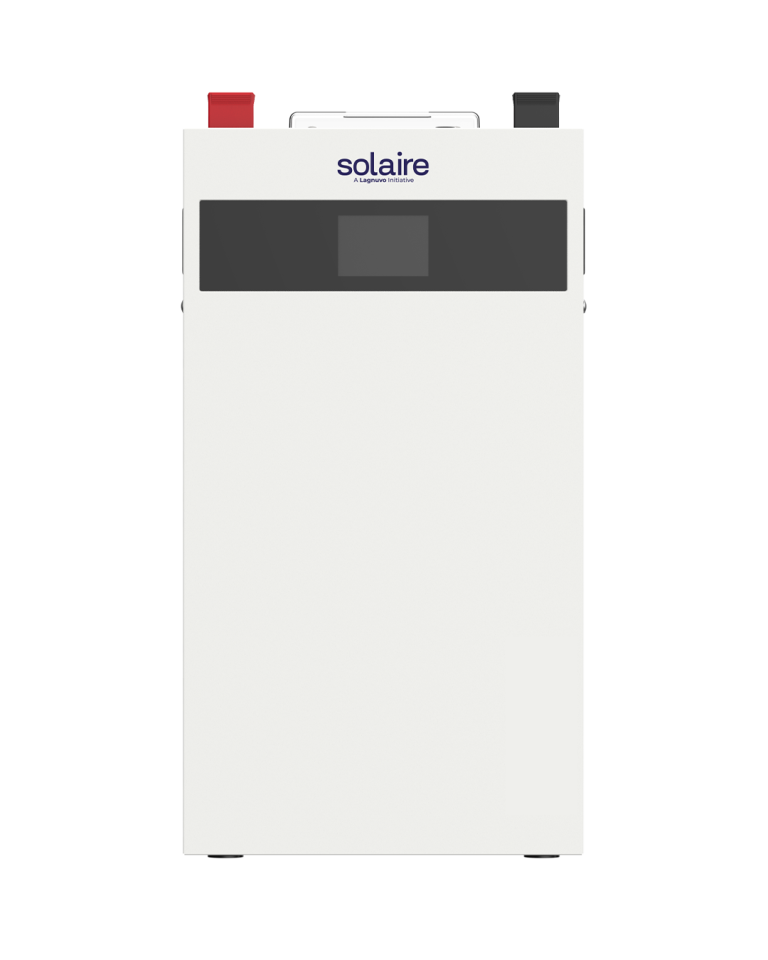

For years, the idea of storing solar energy at home in India was synonymous with bulky lead-acid batteries. These batteries were cheap upfront. However, they were plagued by short lifespans, maintenance headaches, and limited usable capacity. The arrival of lithium iron phosphate, or LFP, chemistry has fundamentally changed the economics and practicality of home energy storage. Paired with a modern hybrid solar inverter, an LFP solar battery bank is now a strong option for a rooftop solar system across India. Solaire, a leading solar solution company in India, has built its energy storage range around LFP technology for exactly this reason.
What Is LFP Chemistry?
Lithium iron phosphate (LiFePO4 or LFP) is a type of lithium-ion battery chemistry where iron phosphate serves as the cathode material. NMC and NCA chemistries are common in electric vehicle batteries. Compared to them, LFP offers three critical advantages for solar power batteries in Indian homes. First, it has superior thermal stability, which means it is less prone to thermal runaway than some other lithium-ion chemistries. Second, it provides a longer cycle life. It typically delivers 3,000 to 6,000 full charge-discharge cycles, compared to just 1,000 to 2,000 cycles for lead-acid. Third, it offers excellent performance in high ambient temperatures. This is a crucial advantage in a country where indoor temperatures can exceed 40°C for months at a time.
How a Hybrid Solar Inverter Manages LFP Batteries
A hybrid solar inverter integrates three functions in one device: a solar PV inverter that converts panel DC to AC, a bidirectional battery charger that can both charge and discharge the LFP battery pack, and a grid interface that manages export limits and import from the grid. The intelligent energy management software inside the inverter decides system actions in real time. It chooses which source powers your loads and determines whether to charge or discharge the battery. It also controls how much surplus power to export to the grid. All of these actions are optimised to minimise your electricity bill while maximising battery lifespan.
Solaire’s hybrid range is factory-configured for seamless integration with its own Lithium Energy Storage Battery series. This plug-and-play compatibility helps prevent the communication issues that sometimes arise when mixing batteries and inverters from different solar companies in India.
Cycle Life: Why LFP Batteries Win for Solar Applications
A rooftop solar system in a typical Indian home will cycle the battery once per day. The system charges the battery during the day and discharges it in the evening. Over a 10-year period, that is approximately 3,650 cycles. Lead-acid batteries typically degrade significantly after 500 to 800 cycles and fail completely well before the 10-year mark, requiring replacement and adding significantly to lifecycle cost. An LFP solar battery from Solaire rated at 4,000 cycles will still retain over 80% of its original capacity at the end of the same 10-year period, delivering genuine decade-long performance.
Safety in Indian Home Environments
Safety is paramount when discussing solar power batteries installed inside or adjacent to a home. LFP chemistry decomposes gradually when overheated rather than igniting explosively. Combined with Solaire’s built-in BMS that monitors cell-level temperature, voltage, and current, and protects against overcharge, over-discharge, and short circuits, the safety profile of an LFP battery-equipped solar inverter system is extremely high. This remains true even in the heat and humidity of a Kerala or Kolkata home.
Sizing Your Battery Bank
The right LFP battery capacity depends on your daily consumption pattern, the size of your solar panels, and how many hours of backup you need during a power cut. As a starting point, you can pair a 5 kWh battery with a 5 kW hybrid solar inverter. This setup covers essential evening loads like lighting, fans, a television, and a refrigerator. It can power these appliances for 6 to 8 hours without any grid input. Solaire’s modular battery design allows capacity to be expanded incrementally, so you can start small and add modules as your budget and energy needs grow.
Conclusion
The combination of LFP solar batteries and a smart hybrid solar inverter represents a capable and cost-effective home energy storage solution available in India today. Whether you are a homeowner in Thrissur seeking independence from erratic grid power, a business owner in Dehradun looking to cut peak-hour electricity bills, or a solar system company in India specifying equipment for your clients, Solaire’s hybrid inverter and solar battery range offers the technology and local support network to back up your installation.

