
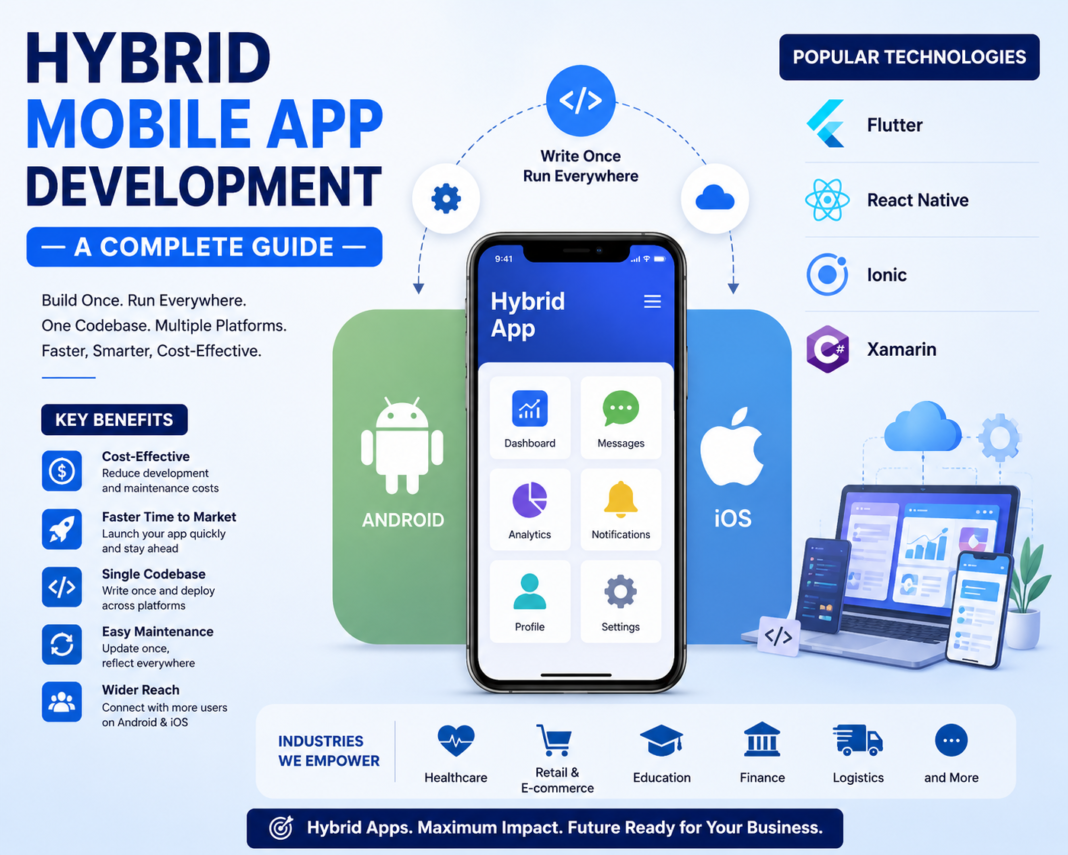

In today’s fast-paced digital landscape, businesses are under constant pressure to deliver high-quality mobile applications that reach users across multiple platforms while staying within budget and development timelines. This is where hybrid mobile app development has emerged as a game-changing solution. Companies of all sizes are increasingly investing in hybrid applications to maximize their market reach, reduce development costs, and accelerate product launches.
In today’s fast-paced digital landscape, businesses are under constant pressure to deliver high-quality mobile applications that reach users across multiple platforms while staying within budget and development timelines. This is where hybrid mobile app development has emerged as a game-changing solution. Companies of all sizes are increasingly investing in hybrid applications to maximize their market reach, reduce development costs, and accelerate product launches.
What is Hybrid Mobile App Development?
Hybrid mobile app development is the process of creating applications that can run on multiple operating systems—primarily Android and iOS—using a single codebase. Unlike native apps, which require separate development for each platform, hybrid apps leverage technologies such as HTML, CSS, JavaScript, and modern frameworks like Flutter, React Native, and Ionic.
The biggest advantage is code reusability. Developers write the application once and deploy it across multiple platforms, significantly reducing both development time and maintenance costs.
This approach has become increasingly popular because businesses no longer need to maintain two independent development teams for Android and iOS
Why Businesses Prefer Hybrid Mobile Apps
Modern consumers expect seamless experiences regardless of the device they use. Hybrid applications make it easier for organizations to meet these expectations while optimizing their development budgets.
Some major reasons businesses choose hybrid apps include:
- Faster development cycles
- Lower overall development costs
- Easier maintenance
- Consistent user experience
- Wider audience reach
- Simplified updates
- Faster market entry
A professional hybrid mobile app development company helps organizations build applications that combine excellent performance with cost efficiency.
Key Benefits of Hybrid Mobile App Development
1. Cost-Effective Development
Building separate native applications for Android and iOS requires two development teams, two codebases, and significantly higher maintenance costs.
Hybrid development allows businesses to create one application that works across multiple platforms, reducing overall project expenses.
For startups with limited budgets, this approach offers tremendous value while maintaining quality.
2. Faster Time to Market
Speed is often a competitive advantage.
Since developers maintain only one codebase, new features, updates, and bug fixes can be implemented simultaneously across all supported platforms.
This enables companies to launch products faster and respond quickly to changing customer demands.
3. Easier Maintenance
Maintaining multiple native applications can become expensive over time.
Hybrid applications simplify maintenance by centralizing updates within one codebase. Businesses save both time and operational costs while ensuring users receive consistent improvements.
. Wider Market Reach
Publishing applications for both Android and iOS increases visibility and customer engagement.
Hybrid development allows businesses to reach a larger audience without doubling development efforts.
This broader reach contributes directly to higher downloads, increased user engagement, and better return on investment.
5. Consistent User Experience
Modern hybrid frameworks deliver interfaces that closely resemble native applications.
Users enjoy smooth navigation, responsive layouts, and attractive designs regardless of the device they use.
Consistency strengthens brand identity while improving customer satisfaction.
Hybrid vs Native App Development
Choosing between hybrid and native development depends on business goal
Hybrid App Development
- Single codebase
- Lower development cost
- Faster deployment
- Easier maintenance
- Ideal for startups and growing businesses
Native App Development
- Separate codebases
- Higher development cost
- Maximum device performance
- Better hardware integration
- Suitable for graphics-intensive applications
For many organizations, hybrid development provides the ideal balance between affordability, scalability, and performance.
Industries Benefiting from Hybrid Mobile Apps
Hybrid applications are transforming businesses across various sectors.
Healthcare
Hospitals and healthcare providers use hybrid apps for:
- Patient portals
- Telemedicine
- Appointment scheduling
- Prescription management
Retail and E-commerce
Retail businesses leverage hybrid applications for:
- Online shopping
- Product catalogs
- Mobile payments
- Customer loyalty programs
Education
Educational institutions benefit through:
- Online learning
- Student management
- Digital classrooms
- Assignment tracking
Finance
Financial organizations utilize hybrid apps for:
- Mobile banking
- Digital wallets
- Investment tracking
- Secure transactions
Logistics
Transportation companies improve efficiency using
- Fleet management
- GPS tracking
- Delivery management
- Inventory monitoring
Role of an Enterprise Application Development Company
While customer-facing mobile applications drive engagement, organizations also require powerful internal software systems to improve operational efficiency.
An experienced enterprise application development company specializes in building customized enterprise software solutions that streamline workflows, automate repetitive tasks, and enhance collaboration.
Enterprise applications commonly include:
- Customer Relationship Management (CRM)
- Enterprise Resource Planning (ERP)
- Human Resource Management Systems (HRMS)
- Inventory Management
- Business Intelligence Dashboards
- Supply Chain Management Solutions
When integrated with hybrid mobile applications, these enterprise systems create a unified digital ecosystem that supports long-term business growth.
Essential Features of a Modern Hybrid Mobile App
Today’s users expect advanced functionality beyond basic interfaces.
Successful hybrid applications typically include:
- Secure authentication
- Push notifications
- Cloud integration
- Offline functionality
- Real-time synchronization
- Payment gateway integration
- AI-powered recommendations
- Analytics dashboards
- Multi-language support
- Social media integration
A skilled hybrid mobile app development company ensures these features are implemented while maintaining excellent application performance and security.
Popular Technologies Used in Hybrid Development
Several modern frameworks have significantly improved hybrid application performance.
Flutter
Flutter offers fast rendering, attractive UI components, and excellent cross-platform performance.
React Native
Developed by Meta, React Native enables developers to build high-performance mobile applications using JavaScript and reusable components.
Ionic
Ionic is ideal for web-based hybrid applications that require rapid development and flexible customization.
Xamarin
Xamarin allows developers to create enterprise-grade mobile applications using C# and the .NET ecosystem.
Selecting the right technology depends on project complexity, performance requirements, scalability goals, and future expansion plans.
Conclusion
Hybrid mobile app development has become a smart solution for businesses seeking cost-effective, scalable, and high-quality mobile applications. By using a single codebase, companies can reduce development costs, accelerate time to market, and deliver consistent user experiences across platforms. Partnering with an experienced hybrid mobile app development company ensures innovative, secure, and future-ready applications that support long-term business growth and digital success.

